26652

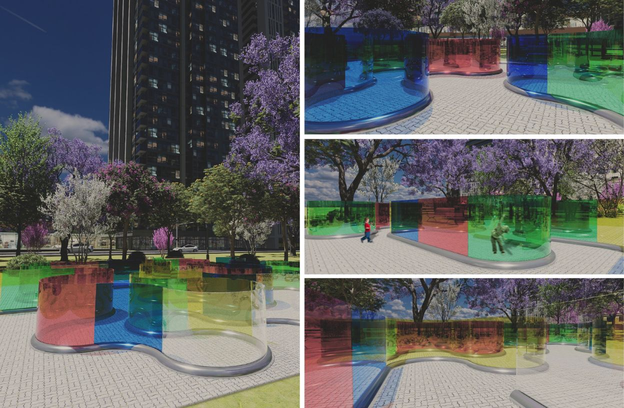
Design of play spaces through exploration, abstraction and scale, where form becomes experience and movement shapes new ways of inhabiting and discovering the environment.
África Magro, Diego Fernandez, Juana Tomas, Maria Eleveens, Paola Prado, Valeria Bechara and Valeria Chao
Ana Matos
Interiors, Grado en Marketing
2025
The project involves the design of a playground or children’s recreational area, conceived as a space for exploration where children discover their surroundings through movement and direct interaction with the environment. Far from following a single typology, these spaces are envisioned as open and heterogeneous configurations, capable of stimulating curiosity, play, and autonomy. The proposal builds on compositions previously developed by the student, taking as a reference one of the configurations inspired by Paul Klee’s The City. This initial image is interpreted as an abstraction —in plan or section— serving as the foundation for the development of the project. From this base, the necessary variations are introduced to ensure the design’s feasibility and its adaptation for real use.