26639

Creation of objects through everyday use, transformation, and appropriation, revealing invisible stories and the material memory that each gesture leaves on the world around us.
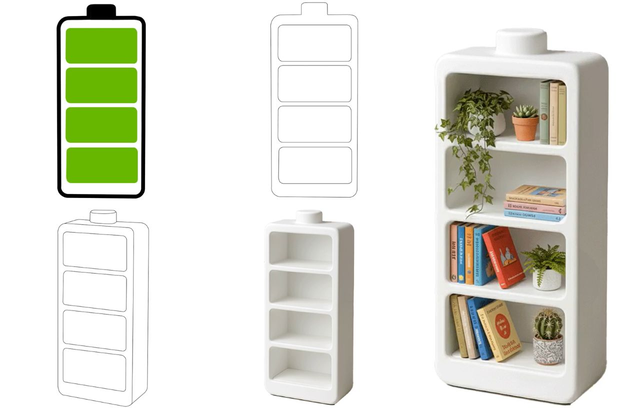
Camille Amado, Shahd Kamal, Carmen Juárez, Lucía Porras, María Vargas, Patricia Montoto, Alba Godoy, Andrea Serrano and Tamara
Vicente Pérez and Paloma Rodera
Design, Grado en Diseño
2025
This session invites students to think about objects beyond their function, discovering in them a material and symbolic memory that reflects both the world and those who inhabit it. The aim is to reveal the invisible stories that objects contain: traces of use, improvised repairs, and the marks of time that transform what is made into something lived.
Michel de Certeau, in The Practice of Everyday Life (1980), shows that daily life is full of invisible creative gestures, where users reinterpret and adapt objects beyond their original function. Each use, adaptation, or “misuse” becomes a tactic of symbolic resistance and a way to inventively appropriate the world. Everyday examples include a cup used as a pencil holder or a chair repaired with rope. The classroom thus becomes a space to observe and reflect on this interaction between creation and appropriation.
“Usage is a silent production.” — Certeau
The anthropologist Tim Ingold, in Making: Anthropology, Archaeology, Art and Architecture (2013), proposes a dynamic view of the object: things are not made, they are in the process of becoming. They are not closed entities, but networks of relationships between materials, bodies, time, and action. An object is not owned; it is co-inhabited and co-evolves, with its wear, use, and transformation forming part of its material biography. Design, therefore, is understood as accompaniment rather than domination: the designer initiates processes that others will continue to modify.
“Things grow within a world of flows; they are not produced outside of it.” — Ingold
In The System of Objects (1968), Jean Baudrillard analyses how everyday objects are part of a social language: they do not merely serve, but signify. Each object communicates values, ideologies, or symbolic belonging, acting as a cultural code that defines identities. When an object wears out or is repaired, it loses economic value but gains affective or ethical value. Repair thus becomes a symbolic act, restoring the relationship with time and challenging the logic of consumption.
“The used object, the loved object, is the true human object.” — Baudrillard
This session does not aim to create anything new, but to learn to observe what already exists. Observing, narrating, and reinterpreting the objects in the everyday environment becomes an exercise in emotional and design archaeology, where each student learns to detect creative and reflective potential in the ordinary.
To inhabit design means recognizing that designing is not just about projecting forms, but also about living with them, transforming them, and giving them meaning over time.
The project culminates in a collective exhibition of material biographies, where objects cease to be mere things and become testimonies of everyday experience and creativity. Each piece tells a story of transformation: a chair that learned to support in a new way, a garment that continued to live in a new body, an anonymous object that, when listened to, regained its voice.