Admissions:+34 918257554
Students:+34 914146611
Whatsapp
16942

What are you looking for?

Ej: Design degree, admissions, events...

Creative Campus Degree in Design
We have been part of:

Bachelor's Degree in Design Madrid

Those who think globally in design will dominate the future. Learning in an international, multidisciplinary and innovative environment will open doors to become a designer.
  • Official degree
  • Campus-based
  • 4 Years, 240 ECTS

Degree in Design

Official degree issued by Universidad Europea de Madrid

Madrid (centro)
Start: 14 sep. 2026
Classes in English or Spanish
School of Architecture, Engineering, Science and Computing - STEAM

The Degree in Design at Universidad Europea is a four-year programme taught in English that will give you the skills and knowledge to succeed in many areas of design such as multimedia and audiovisual design, UX design, web design and more. Based at our Creative Campus in the very heart of Madrid, the Design Degree, which consists of 240 ECTS, covers subjects such as branding, photography and digital imaging, and sustainable design.

The Bachelor in Design is taught by leading experts who are still active professionals, meaning you will get the latest design industry knowledge and keep up to date with trends in the sector. In addition, you will take part in work placements and internships at organisations across the design sector, allowing you to build up your network of contacts and decide on what area of design you would eventually like to specialise in.

Why study for a Degree in Design?

Creative Campus facilities

5,000m2 area in the centre of Madrid with state-of-the-art facilities. Atrio, the meeting point for students, professors and professionals where they can carry out exhibitions, presentations, performances, lectures, screenings, and more.

Inernational nature

Training as a designer allows you to create projects that will influence the way in which we interact, experience and live reality at all levels. Starting your studies as part of multicultural and multidisciplinary teams enriches your university experience and will be part of your CV forever.

Generalist design

Learn to discover and experiment with all the disciplines of design. You will have the opportunity to have a full comprehensive learning experience.

University Certificate in Branding and Motion Graphics

This programme is built on a simple idea: your portfolio is the key to entering the professional world of design. That’s why every module is designed to help you create real, industry-ready projects, with the knowledge you need to bring them to the highest standard. By the end, you’ll have four strong professional pieces, each with a clear brief, documented process and final outcome—ready to present to the agencies and companies where you want to start your career.

You’ll learn to master After Effects progressively, work on motion applied to real brands, and understand branding as something dynamic that comes to life through movement. The programme is designed to fit alongside your degree without overloading your schedule, and you’ll also explore the use of generative AI in your final project. Here, you don’t choose between motion or branding—you connect them to build a well-rounded, contemporary creative profile that helps you stand out.

diseño gráfico digital

Creative Campus joins the New European Bauhaus

Creative Campus is now an official partner of the New European Bauhaus, the European Commission’s initiative that connects the European Green Deal with people’s everyday lives, promoting a sustainable, inclusive, and beautiful transformation of the spaces we inhabit.

Becoming part of this European community strengthens our commitment to an education grounded in the design of real, sustainable, and inclusive solutions. It also opens new opportunities to collaborate with European institutions, cultural stakeholders, and companies, fostering a learning environment that combines creativity, innovation, and social responsibility.

Together, we actively contribute to shaping a more humane and sustainable future.

Our students’ work
Design
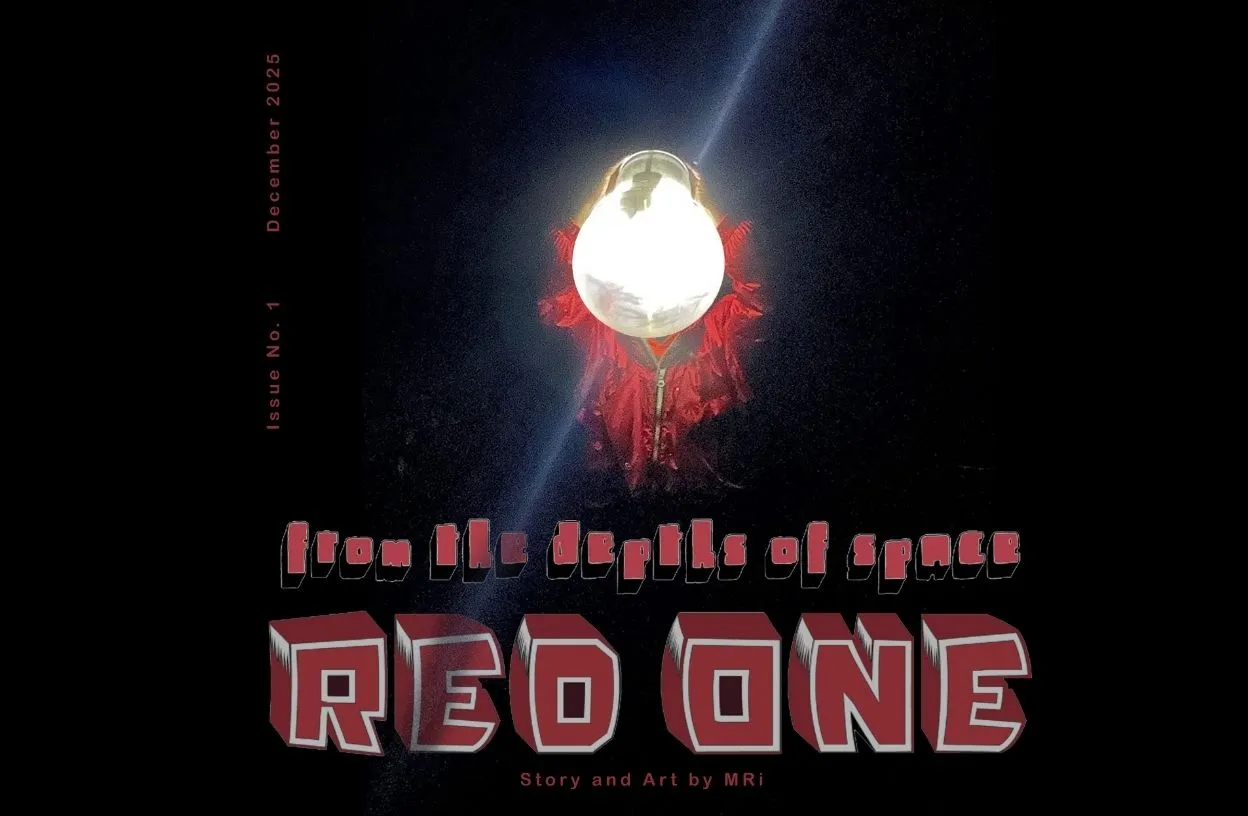
Red One
Design
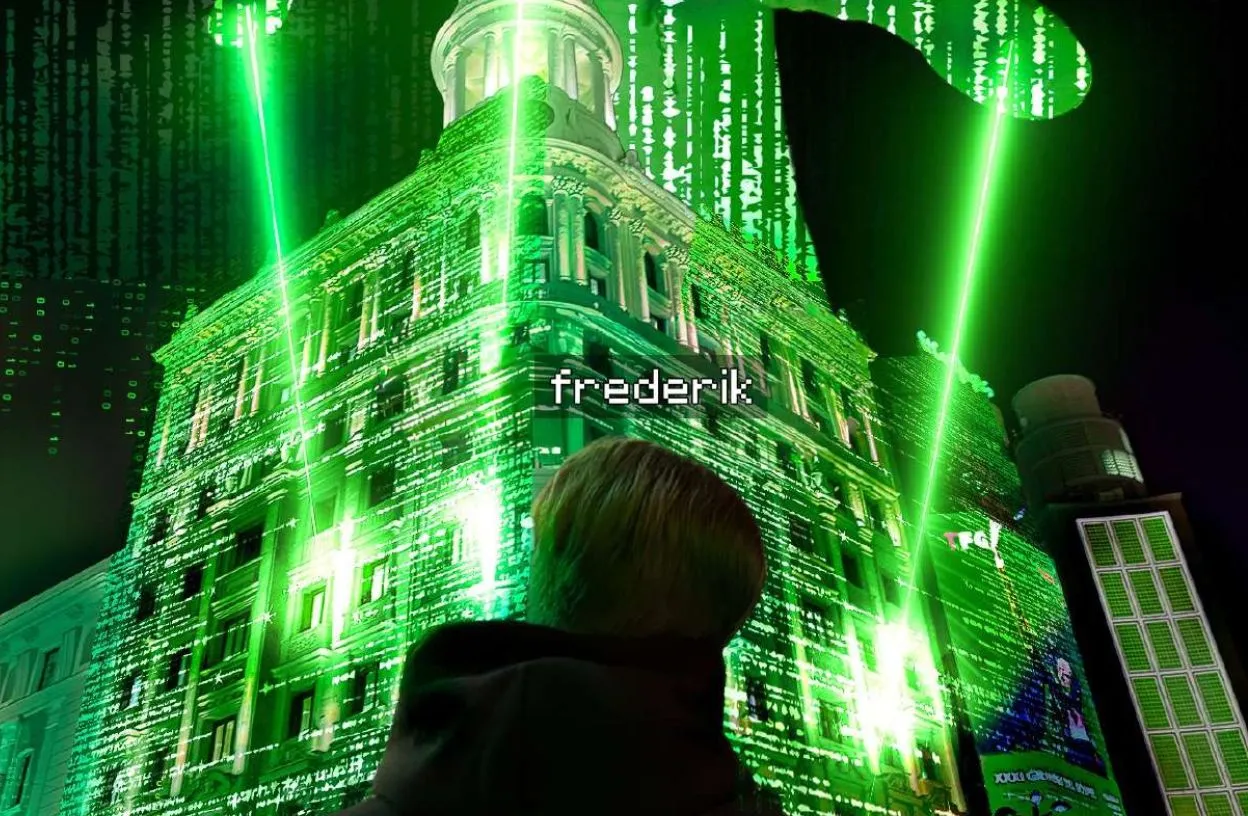
Fiction Report
Design
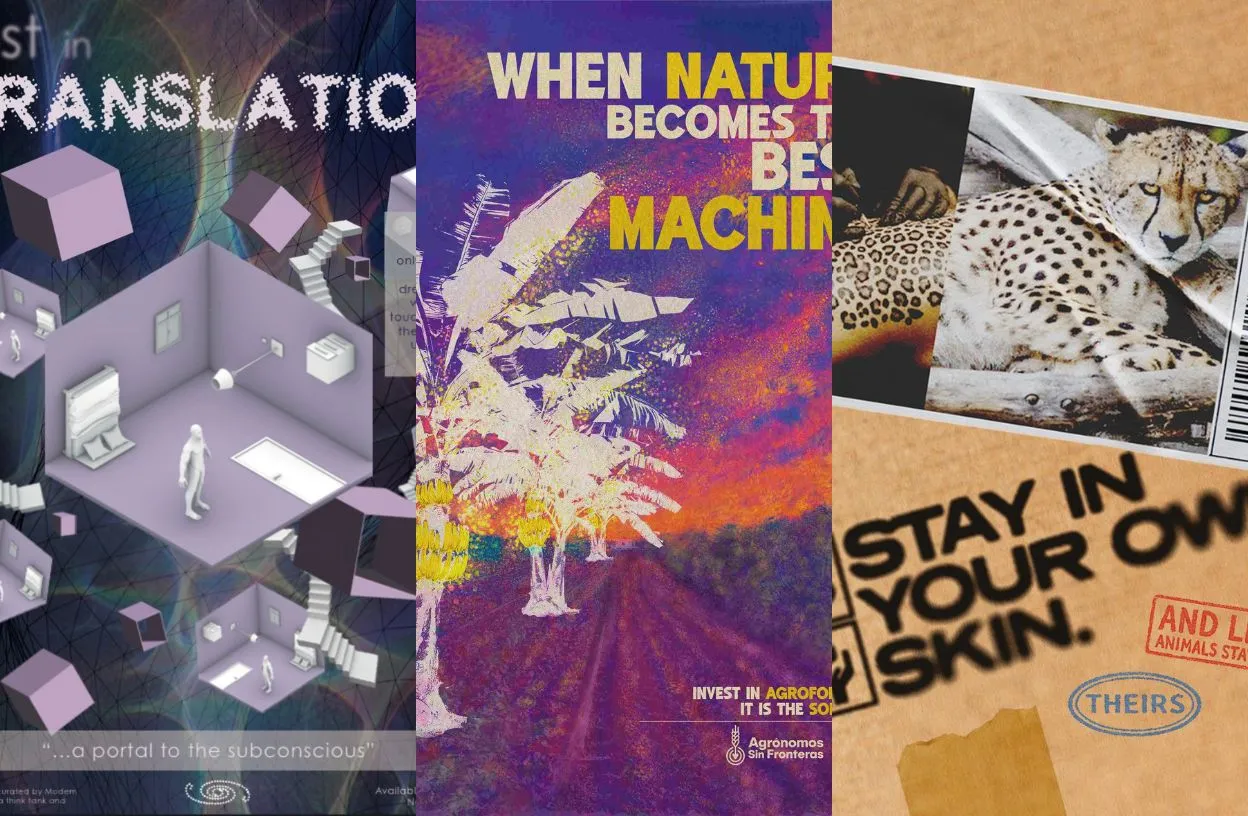
Ecological Awareness Posters

We invite you to discover Creative Campus

The training hub for design and creative technologies where you will acquire the knowledge and experience to develop as a future designer or creator. You will learn to find innovating solutions to the new challenges of society.

A space where you can grow, discover and enhance your creativity thanks to contact with relevant professionals in the sector, leading companies, agencies and studios with whom you can work on real projects.

A space where you can learn with an experiential academic model and which offers activities and university life revolved around design, culture, art, innovation and technology that will enhance your skills and abilities.

Demo Interior instalaciones Creative Campus

Study plan

FIRST YEAR

MateriaECTSTipoIdioma de impartición
Drawing I6CoreEnglish
Photography and Digital Imaging6CoreEnglish
History of Art, Design and Architecture6CoreEnglish
Professional Ethics and Efficiency6CoreEnglish
Drawing II: Digital Drawing6CoreEnglish
Mathematics and Physics Applied to Design6CoreEnglish
Workshop I: Experiments6CompulsoryEnglish
Geometric Representation Systems6CoreEnglish
Drawing and Analysis of Spaces and Objects6CompulsoryEnglish
Materials, Models and Prototypes6OptionalEnglish

SECOND YEAR

MateriaECTSTipoIdioma de impartición
2D Design Workshop6CoreEnglish
3D Design Workshop6CoreEnglish
Theory of Audiovisual and Interactive Media6CoreEnglish
Relational Impact and Influence6CoreEnglish
Image6CoreEnglish
People and Environment: User Experience Design6CompulsoryEnglish
Workshop II: Sustainable Design6CompulsoryEnglish
Workshop III: Digital Manufacturing and Parametric Design6CompulsoryEnglish
Typography6OptionalEnglish
Spatial Planning of Furniture Workshop6OptionalEnglish

THIRD YEAR

MateriaECTSTipoIdioma de impartición
Creativity Techniques6CompulsoryEnglish
Workshop IV: Events design6CompulsoryEnglish
Workshop V: Exhibition Spaces and Signage6CompulsoryEnglish
Physical Interaction Workshop6CompulsoryEnglish
Technology for Multimedia Production6CompulsoryEnglish
Off-line Graphic Design Technologies6OptionalEnglish
Web Design Technology6OptionalEnglish
Branding6OptionalEnglish
Interior Design Proyects I6OptionalEnglish
Product Design Projets I6OptionalEnglish

FOURTH YEAR

MateriaECTSTipoIdioma de impartición
Entrepreneurial Leadership6CompulsoryEnglish
Communications and Marketing6CompulsoryEnglish
Design Management6CompulsoryEnglish
Workshop VII: Project Creation6CompulsoryEnglish
External Internship6CompulsoryEnglish
End of Degree Proyect6CompulsoryEnglish
University Activities6OptionalEnglish

More information

90

2017/2018

Internships in companies are a key element in your training. Gaining experience after what you have learned in your degree is the best way to enter the labor market. There are two types of internships, curricular (included in your curriculum) and extracurricular (those you can do voluntarily).

To carry out curricular internships in companies, you will need to have 50% of the credits approved and enroll the subject before starting your internship. These practices are monitored by the company and the internship teacher, as well as the realization of intermediate and final reports for evaluation.

If you want to improve your work experience before finishing your university education, you can do extracurricular internships. You can do them in any course but we remind you that the practices are a training complement to your studies; Therefore, the more knowledge you have acquired throughout the career, the more you will get out of the internship experience.

Core competencies

  • CB1. Students should have demonstrated that they possess and understand knowledge in a field of study building on the foundations of general secondary education, typically at a level which, whilst drawing on advanced textbooks, also includes some aspects involving knowledge at the forefront of their field of study.
  • CB2. Students should be able to apply their knowledge to their work or vocation in a professional manner and possess the Competencies typically demonstrated through the formulation and defence of arguments and problem-solving within their field of study.
  • CB3. Students should have the ability to gather and interpret relevant data (usually within their field of study) to form judgements that include reflection on relevant social, scientific or ethical issues.
  • CB4. Students should be able to communicate information, ideas, problems and solutions to both specialist and non-specialist audiences.
  • CB5. Students should have developed the learning skills necessary to undertake further study with a high degree of autonomy.

Cross-disciplinary competencies

  • CT1. Independent Learning: Skill in choosing the strategies, tools and times deemed most effective for learning and in independently applying what has been learnt.
  • CT2. Self-confidence: The ability to assess one’s own results, performance and capabilities with the inner conviction that one is capable of tackling the tasks and challenges presented.
  • CT3. Ability to adapt to new situations: being able to assess and understand different perspectives, adapting one’s own approach as the situation requires.
  • CT4. Ability to analyse and synthesise: being able to break down complex situations into their constituent parts; also conducting assessment of other alternatives and perspectives to find optimal solutions. Synthesis seeks to reduce complexity in order to understand it better and/or solve problems.
  • CT5. Ability to apply knowledge in practice, to use knowledge acquired in an academic setting in situations as close as possible to the reality of the profession for which they are training.
  • CT6. Oral and written communication: ability to convey and receive information, ideas, opinions and attitudes to achieve understanding and action, with oral communication taking place through words and gestures and written communication through writing and/or visual aids.
  • CT7. Awareness of ethical values: Ability to think and act in accordance with universal principles based on the value of the individual, aimed at their full development and entailing a commitment to certain social values.
  • CT8. Information management: The ability to seek, select, analyse and integrate information from diverse sources.
  • CT9. Interpersonal skills: The ability to interact positively with others through verbal and non-verbal means, via assertive communication, understood as the ability to express or convey what one wants, thinks or feels without causing discomfort, aggression or hurt to the other person’s feelings.
  • CT10. Initiative and entrepreneurial spirit: Ability to tackle difficult or risky tasks with determination. Ability to anticipate problems, propose improvements and persevere in achieving them. Preference for taking on and carrying out activities.
  • CT11. Planning and time management: Ability to set objectives and choose the means to achieve them, using time and resources effectively.
  • CT12. Critical reasoning: The ability to analyse an idea, phenomenon or situation from different perspectives and adopt one’s own personal approach to it, based on rigour and reasoned objectivity, rather than intuition.
  • CT13. Problem-solving: The ability to find a solution to a confusing issue or a complicated situation with no predefined solution, which hinders the achievement of a goal.
  • CT14. Innovation-Creativity: Ability to propose and develop new and original solutions that add value to the problems posed, including from fields other than that of the problem itself.
  • CT15. Responsibility: The ability to fulfil the commitments a person makes to themselves and to others when carrying out a task and striving to achieve a set of objectives within the learning process. The ability, present in every individual, to recognise and accept the consequences of an action freely undertaken.
  • CT16. Decision-making: Ability to choose between existing alternatives or methods to effectively resolve different situations or problems.
  • CT17. Teamwork: The ability to integrate and collaborate actively with other people, fields and/or organisations to achieve common objectives.
  • CT18. Use of Information and Communication Technologies (ICT): Ability to use information and communication technologies effectively as a tool for searching for, processing and storing information, as well as for developing communication skills.

Specific competencies

  • CE1. Ability to master colour theory and its applications, as well as the analysis and theory of form and the laws of visual perception.
  • CE2. Ability to apply the concepts of metric and projective geometry and spatial representation systems to design.
  • CE3. Ability to use graphic representation techniques as a tool for analysis, ideation, Communication and expression in design.
  • CE4. Ability to apply computer tools to the representation of objects and spaces, in both two and three dimensions.
  • CE5. Ability to apply knowledge of the principles of physics, dimensioning, numerical calculation, analytical geometry and core algebraic methods to design projects.
  • CE6. Ability to understand the various applications of symbolisation processes, semiotics, practical functions, use and ergonomics in design.
  • CE7. Knowledge of theories of form and composition to create designs that meet users’ needs and requirements, and which are consistent with the relationship between form, function and the context in which they may be used.
  • CE8. Knowledge of the history of art and design, their technical evolution and the criteria by which certain works are considered models of reference
  • CE9. Ability to analyse different works of art and design in order to situate them within their historical, cultural and stylistic context.
  • CE10. Ability to critically assess works of art and design in a comprehensive manner, developing the discipline’s specific vocabulary and expressing conclusions objectively, rigorously and precisely.
  • CE 11. Ability to apply graphic, product and interior design technologies and tools in the different phases of design creation and production.
  • CE12. Ability to make value judgements by analysing cases within professional activity from an ethical perspective.
  • CE13. Ability to develop communication skills for the effective conveyance of ideas within a working group.
  • CE14. Ability to create and develop design projects applied to digital, multimedia and web environments.
  • CE15. Ability to make reasoned decisions, adapt behaviour to different situations and adopt a leadership style appropriate to each situation.
  • CE16. Ability to develop critical, creative and reflective thinking within the professional field of design.
  • CE17. Ability to create and develop design projects that incorporate the principles of universal accessibility and the removal of architectural barriers.
  • CE18. Knowledge of the principles of sustainability and the conservation of energy, material and environmental resources, to apply them in the creation and development of product and interior design projects.
  • CE19. Knowledge of professional organisation and the business models of companies related to the design sector.
  • CE20. Ability to write and defend, before a University Examination Board, an original academic dissertation undertaken individually and related to any of the disciplines studied.

Employability

  • Corporate identity.
  • Visual identity.
  • Editorial design.
  • Graphic production.
  • Packaging.
  • Art direction in advertising
  • Audiovisual design
  • Multimedia design.
  • Interaction design.
  • Web design.
  • Graphic design and spatial communications.
  • Research and teaching.
  • UX design.
  • Publishing agencies.
  • Home design and interior living spaces.
  • Commercial and leisure space design.
  • Administrative space design.
  • Cultural, educational and recreational space design.
  • Ephemeral architecture design (fairs, events...).
  • Exhibition design.
  • Stage design.
  • Restoration.
  • Public space design.
  • Business management of creative activities
  • Interior design for transport.
  • Works management and risk prevention in the field of interior design.
  • Project management in the field of interior design.
  • Research and teaching.
  • Architectural offices.
  • Home design and interior living spaces.
  • Commercial and leisure space design.
  • Administrative space design.
  • Cultural, educational and recreational space design.
  • Ephemeral architecture design (fairs, events...).
  • Exhibition design.
  • Stage design.
  • Restoration.
  • Public space design.
  • Business management of creative activities
  • Interior design for transport.
  • Works management and risk prevention in the field of interior design.
  • Project management in the field of interior design.
  • Research and teaching.
  • Architectural offices.

Admissions

Start your future at Universidad Europea

You can become a student at Universidad Europea in three easy steps.

1

Admission exams

Start your admission process by calling +34 918257503 or request information and our advisors will contact you.

2

Place reservation

Once you have been admitted, secure your place by paying the reservation fee.

3

Enrollment

Submit the required documents to formalise your enrollment.

Scholarships and financial aid

We want to help you. If you want to study at Universidad Europea, you will have at your disposal a wide selection of own and official scholarships.

Credit recognition and transfers

You don’t have to stick with something you don’t like. That’s why we’ve designed specific plans for credit recognition and transfers.

Request your online credit recognition review, transfer your academic file and start studying at Universidad Europea.

Open Days

We know that now is an important moment to progress in your professional future. That is why we open our virtual doors to you and invite you to join us. We want you to meet the director of your programme and solve all possible doubts you have. You’ll also discover what makes our students and our online methodology unique.

Sign up

17 April

Jornada de Puertas Abiertas | Creative Campus Universidad Europea
Boceto del Interior del Creative Campus

Come and see the campus

Get to know the facilities and discover why Universidad Europea is made for you.

Faculty

  • Gomez , Kenneth
    Ken graduated from Central St Martins, University of the Arts London with a BA Hons in Industrial Design. He has worked in the fields of architectural design, retail and interior design, brand communication, furniture and product design. He has worked for both small independent design studios as well as for large international consultants, such as Foster and Partners and on projects ranging from the Seville Expo 1992 to one off designs for individual clients. He has taught design at institutions such as the Instituto Europeo de Design and the Creative Campus of the Universidad Europea.
  • Marcos Solorzano, Isabel
    Isabel Marcos is a visual artist, educator, and researcher. She holds bachelor degrees in Fine Arts and Architecture from Universidad Europea de Madrid and an MFA from the Dutch Art Institute. She has taught at Universidad de Castilla-La Mancha, Academie Minerva Hanze Hogeschool and the Istituto Europeo di Design, and has served as an affiliated researcher at the Universiteit van Amsterdam. Currently, she combines teaching at UEM with her artistic practice, co-directing the editorial project Kilo Translation, and pursuing doctoral research at UCLM. Her work has been presented internationally and supported by institutions such as Mondriaan Fonds, CBK Rotterdam, Fundación Montemadrid, AECID, Injuve, Fundación BBK, Fundación Vegap, among others.
  • Moerel , Marre
    Moerel graduated in 1991 with a Masters Degree in furniture design from the Royal College of Arts in London (UK). In 1993 she moved to New York City, where she worked and exhibited for 10 years as freelance designer and fine artist, whilst teaching furniture design at Parsons School of Design (1995-1999). In 2002, to expand her horizons and in search for new inspiration, Moerel moved to Madrid, Spain, where she established her own design studio/gallery Marre Moerel Design Studio. From here she works on her own collections of design objects whilst collaborating with private clients and internationally acclaimed design companies, such as Cappellini and Offect and Santa&Cole. Her work is represented by establisehd galleries such as Rossana Orlandi (IT), Mint (UK) and Aybar Galleries (USA). She continues her teaching practices at various design schools and universities such as the UEM, ETSAM and IED. Both Moerel’s Art and Design have been published and exhibited extensively worldwide. In 2015 she was nominated Most Influencial Designer of the Year by Interiors Magazine.
  • Munari , Isabella
    PhD in Art History (Doctor Europeaus with honours by Università degli Studi di Udine, Italy), with a thesis on the reinterpretation of Titian's s "Glory", since the history of heresy and propaganda and interdisciplinary research, realized between Italy and Spain. Author of the book "Tiziano spirituale" and other articles, she took part in several international conferences (National Gallery of London, University of Toronto, University of Kent, etc.). Her research interests span the entire spectrum of the Visual Arts, from the classical iconology to the applied arts and the contemporary artistic practices, with a main focus on the hybridizations of the visual codes. She is Professor of Art History, Architecture and Design at Universidad Europea de Madrid.
  • Rodera Martinez, Paloma
    PhD in Microsociology, holds a Master’s degree in Theater and Performing Arts, a Bachelor’s in Fine Arts, and a degree in Philosophy. Accredited by ANECA to teach undergraduate and postgraduate courses in Design, Art, and Communication. Researcher at ECObdLab and collaborator with the Madrid City Council. She has exhibited her work at MoMA, MNCARS, and the Botín Center. Founder of TAP Productions and Kleos Art Consulting. Editor-in-Chief at Culturamas since 2012 and author of works on contemporary design.

Academic quality

As part of its strategy, the University has an internal quality plan whose objective is to promote a culture of quality and continuous improvement, and which allows it to face future challenges with the maximum guarantee of success. In this way, it is committed to promoting the achievement of external recognitions and accreditations, both nationally and internationally; the measurement and analysis of results; simplification in management; and the relationship with the external regulator.

View

Internal Quality Assurance System (IQAS)
Monitoring of the degree quality

Members of the Degree Quality Committee (CCT)

  • Undergraduate vice-dean
  • Degree Coordinator
  • Department Director
  • Students
  • Professors (Undergraduate Final Project Coordinator and Internship Coordinator)
  • Quality Partner (Quality and Academic Compliance)
  • Academic Advisor
  • Responsible of Learning Assesment
  • Academic Director

Main Degree results

Main quality results

University regulations